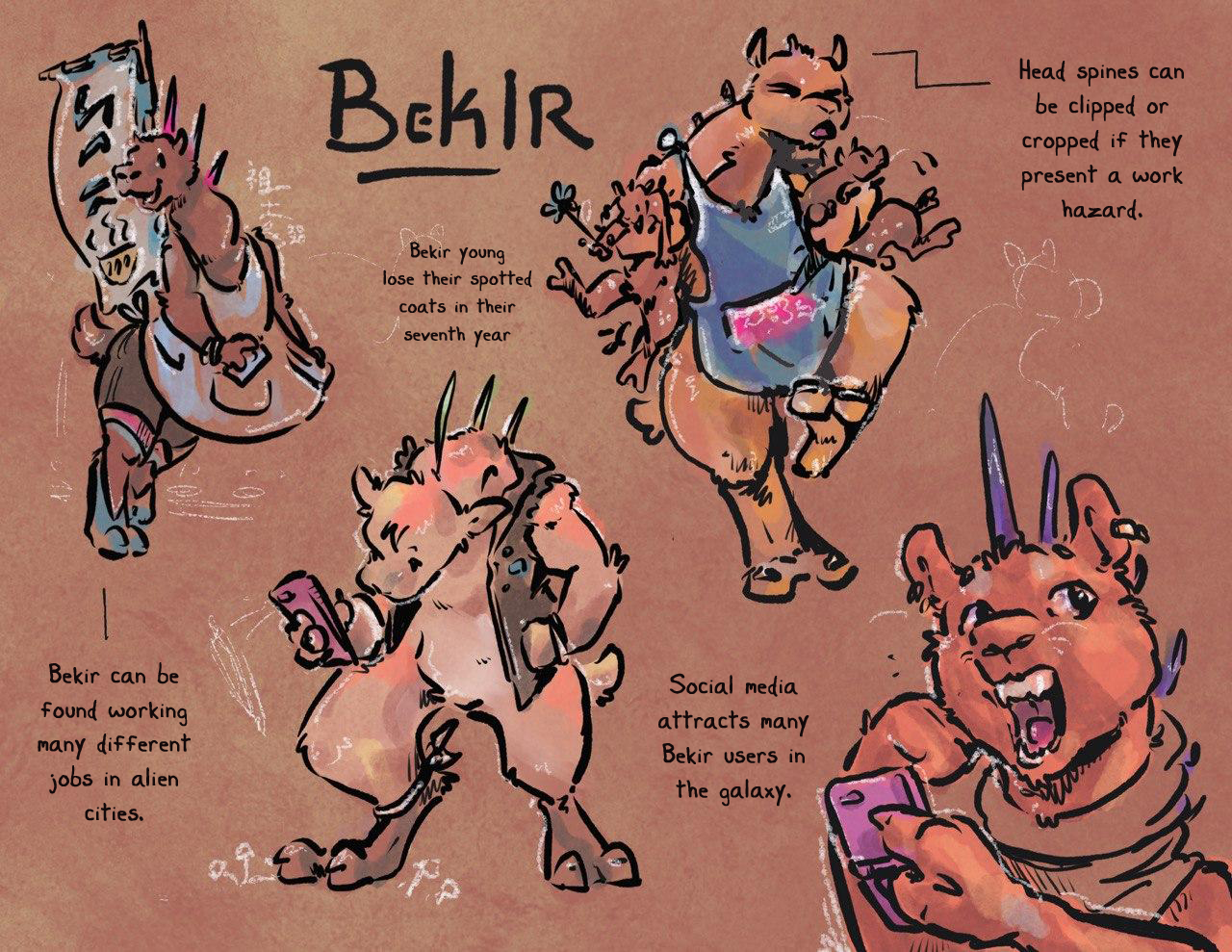
Race Name: Bekir
Homeworld Name: Unknown [foster worlds: Kemadak of Niilo, Inpin II, Inpin III and Lowith of Foros]
Religions: Bandu
Main Cities: Thorasis (in the Niilo system), Dominue, Portanto and Milwe (Foros system)
Biology & Diet
Bekir are large, furred bipeds with advanced frontal lobes and extensive social memories. Their legs are digitgrade, with two toes per foot. The Bekir hand is two fingers and a thumb. With a long neck, nubbed tail and small ears, Bekir are closely related to caviiforme mammals. They are technically an invasive species.
A crest of three to five spikes runs from the top of Bekir skulls down to just above the shoulder blades. The spikes themselves are simply adapted hair folicles and made of keretinous matter and have no nerves, so are often styled or dyed. Musculature in the neck allows Bekir to raise and lower the spines to aid them in communication. When working a job where they could pose a hazard (such as medicine or childcare) Bekir ofen get their spikes clipped or filed. These usually regrow within four months.
Bekir diets are omnivorous and opportunistic, and archeological studies into their various home worlds seems to suggest that the Bekir themselves have evolved from some ancient stow-away pest, pet or livestock on spacefaring ships. Evidence of these ships have been located on all Bekir homeworlds. The technology is ancient and strange, unlike any seen in the modern galaxy. It is supposed that the Bekir through fortune or fostering via the vector gained a foothold on the planets of Inpin II, Inpin III, Kemadak and Lowith and subsequently outlived their vector species. The vector being is thought to be extinct, having died out before Bekir developed written or oral history. No evidence of coordinated colonization efforts by the vector species of the Bekir worlds can be found. The true world of origin for both the vector and the animal which evolved to become modern Bekir is unknown.
Bekir from all four planets in which they are considered the dominant intelligent species are biologically and culturaly similar, exhibiting covergent development in spite of their isolation. Considering that even the Bekir of the Niilo system are not biologically or sociologically distinct from those of Foros, this is uniquely uncanny.
Sexual Dimorphism & Reproduction
To the alien observer there is almost no obvious sexual dimorphism between Bekir. To Bekir, there is a very nuanced and codified language of gender and sex expression which they frequently employ in great depth while flirting. This language, considered variations of the Bekir tongue Unya, is a combination of both spoken and visual communication. Head-spine rattling and shaking convey a great deal of this information. Depending on their flirtation, individual Bekir will often change their presentation and identity several times a year.
Bekir culture is fashionable, social and flashy and so too is their dating scene. Very little about Bekir dating is taken seriously, and when Bekir are actually interested in family or reproduction they tend to dial back their dress and behavior. Generally a Bekir family will be one to four adults taking care of one to four offspring. Bekir children are born after 9 months in uetero and typically either alone or as fraternal twins.
Little sets Bekir reproduction apart from that of most Earth mammals with one minor exception. When stressed or when a fetus does not seem medically viable for survival, Bekir parents who are carrying the still developing child are capable of not only self-aborting but also of absorbing the fetal tissue back into their bodies and thus saving themselves the stress of carrying and birthing a child in a potentially hostile enviroment. While not common to Earth mammals, this adaptation is known to exist for members within the family laporidae.
Language & Culture
Bekir are industrious builders and talented designers who respond well to alternate points of view and feedback due to their gregarious social nature. They tend to be non-confrontational, defending themselves when needed but rarely escelating or initiating hostility. The social needs and nature of Bekir has lead to them dwelling strictly in urban settings and prefering cramped conditions.
Bekir found within the Niilo system seem to prefer subterranian warren-like designs for their cities, but it appears that this was influenced primarily by the colder climate. Those on Foros planets tend to build upwards or outwards as well as downwards, with little preference. Open plains and wide views make Bekir feel uncomfortable and exposed. Bekir will not move to a new place if it is too sparsely populated for their liking.
The culture of Bekir is a complex subject, not just because of Bekir are established on four planets in two solar systems. The length and bredth of individual planetary history can not be covered in depth and so we will focus only on Bekir society as it has progressed since the species bridged the communication gap between all four worlds. Bekir of the Foros system sought to communicate with their interplanetary kin about seventy years ago, Lowith and Inpin II having received communication feedback from Inpin III's space noise. Niilo Bekir -from planet Kemadak- first communicated with their neighboring aliens, the Nikitaks, before becoming aware of the Foros Bekir and reaching out to them. All four populations of Bekir have found ancient wreckage of the ships through which their vector species travelled . It is believed that Bekir themselves must have been influenced by this vector species, but it is unknown to what degree.
Bekir have created a unified language spoken between their worlds called Unya. Unya contains a vocal element, but is primarily communicated by the sounds of shaking and rattling head spikes in varied positions. Though there are differences in language between Bekir cultures (both interstellar and international), Unya was specifically structured to be easy to understand and learn for Bekir of different worlds to communicate. Colloquial modern variations of Unya are most evident in the dating scene.
Personal expression and individuality are highly valued in Bekir society, and most aspects of life (sexuality, politics, religion) is generally viewed as existing on a spectrum. This means that Bekir may vary greatly in their beliefs, behaviors and practices. Overall census data of the four major Bekir populations indicates a general theme, though.
With extensive social memories, Bekir can remember almost every face of every person they have met regardless of how many they have encountered, perhaps leading to their resolve to attempt to engage with others amiably. They are often found living in alien cities.
Religion & Rulerism
Religion as it pertains to four different planets where the same species developed is quite obviously complex, and details are often altered with reference to the worlds they're found upon. There are many subtypes of Bekir religion and different ways to worship. Bekir seem quite welcoming of these alternate takes on their mythology and philosophy, although they do not welcome the Rulerist interpretation.
The primary religious philosophy of the Bekir is called Bandu. While not a true doctrine with a dogma or church, it is the name the four worlds decided upon to refer to their shared creation and death mythos. It is sourced from folklore that has been found to contain commonalities in both solar systems. Bekir do not know their 'true' world of origin, but it is thought by some the creation myth of Bandu must contain clues as to its location.
Themes seen numerous times in Bandu creation mythos are the reference to a "long night of bright silver" as well as great winds. There are also consistant references to "four suns growing and dancing in the sky" which in some way lead to the emergence of the Bekir themselves. The death mythos declares that upon death a soul is raised to join a wall of prior spirits for eternal reward - there is debate as to if this wall is meant to be literal or figurative. The afterlife and when a soul crosses to it are generally treated as times where the "greatest feelings" must be shared. Hero figures are found throughout Bandu mythology, and though names and details may differ, it is clear that they are reference to a small group of characters shared in interplanetary Bekir oral history. In both the Niilo form of Bandu and the Bandu of Foros the death mythos contains the story of a hero by whom Bekir will curse. The curse, loosely translated and devoid of its context, can be read as "tooth and sinew" and generally is meant as a please to save ones' soul. The story this originates from is much more in depth and lengthy in the Foros version of the mythology.
That they are essentially the remnants of an invasive alien invasion has not conciously shaped Bekir religion. The mythology from which Bandu was derived has historically been present in the Foros and Niilo Bekir societies much longer than the knowledge of their vector. Most Bekir see no reason why the two (Bandu and their vector species theory) should not support one another.
Some Bekir have accepted and converted to alien religions - provided they share the belief philosophy. On alien worlds like Nikiticha and Contura, though, it is not uncommon to see several attending alien religious services. For these Bekir, Bandu is more of a cultural unifier than a system of moral or spiritual guidance. Generally churches whose language suggests followers owe service to a God are rejected.
Rulerist missionaries urged Bekir to accept the Ruler as their true religion and to fold the beliefs of Bandu into Rulerism as a whole. This seemed to be going well, until it became clear that to the Rulerists the vector species who brought the Bekir to their worlds was in fact meant to be some avatar of the Ruler, if not the Ruler themselves. Bekir had never seen the need to elevate their vector species to any godlike status. The suggestion then followed from Rulerists that the Bekir must in some way owe servitude to the Ruler for helping them to survive and grow on these alien worlds. Bekir disagreed, and when they attempted to extract themselves from the Rulerist colonies in which these ideas were being floated, several Bekir officials wound up dead.
In the resultant years, Rulerists have denied any such violence. Terms between Bekir and Rulerist groups remain tense to this day.
Technology & Alien Cultures
Bekir are early adopters of technology and technologically advanced in their own right without outside influences. The Bekir of the Foros system created their own reliable form of interplanetary transportation to reach one another shortly after learning they were not alone. The Bekir of the Niilo system collaborated with Nikitaks, their extraterrestrial cousins and the Chuians. Perhaps because of their laid back perspective as well as their proclivity towards social living, Bekir are more willing to understand and work with other aliens. With few exceptions, they seem to get along well anywhere. There are even Bekir living on Rojeria, although they generally don't advise others to do the same.
While it's easy to find Bekir in established metroplis cities, it is harder to find them on the fringes of civilization. A recent study conducted found that until a settlement had surpassed five million residents, Bekir showed no interest in moving there. Once the population density tipped past 5m, Bekir families chose to settle within the colonies. This indicates some instinctive need for population density in Bekir. It's highly uncommon for them to settle somewhere without other Bekir in tow - friends, family, or simply members who all bought passage on a freighter together with the intent of living in a new place as a group.
The strong social bonds which develop for Bekir have made them naturals in terms of developing and utilizing personal communication technology. By way of the Niilo Bekir, trade with Contura for parts and software is quite common and several Bekir call the blue planet their home. It's very common to see Bekir using long distance communication methods - text, voice, video - at the same time as they are interacting with people face to face.
There is little usage of Mychenet by Bekir. This is not for lack of interest in the technology. Myches tend to give the Bekir a bit of a cold reception, harboring a latent jealousy that the Bekir have been able to learn something about the source of their true origin planet through their legends. The lack of overal societal interest by Bekir in hunting down this world bothers the Myches, who have been searching for their own home planet for well over the century the Bekir spent deciding they didn't truly care about theirs. While Bekir attempt to be friendly with Myches, it's a bit of an awkward friendship.
02/2020